
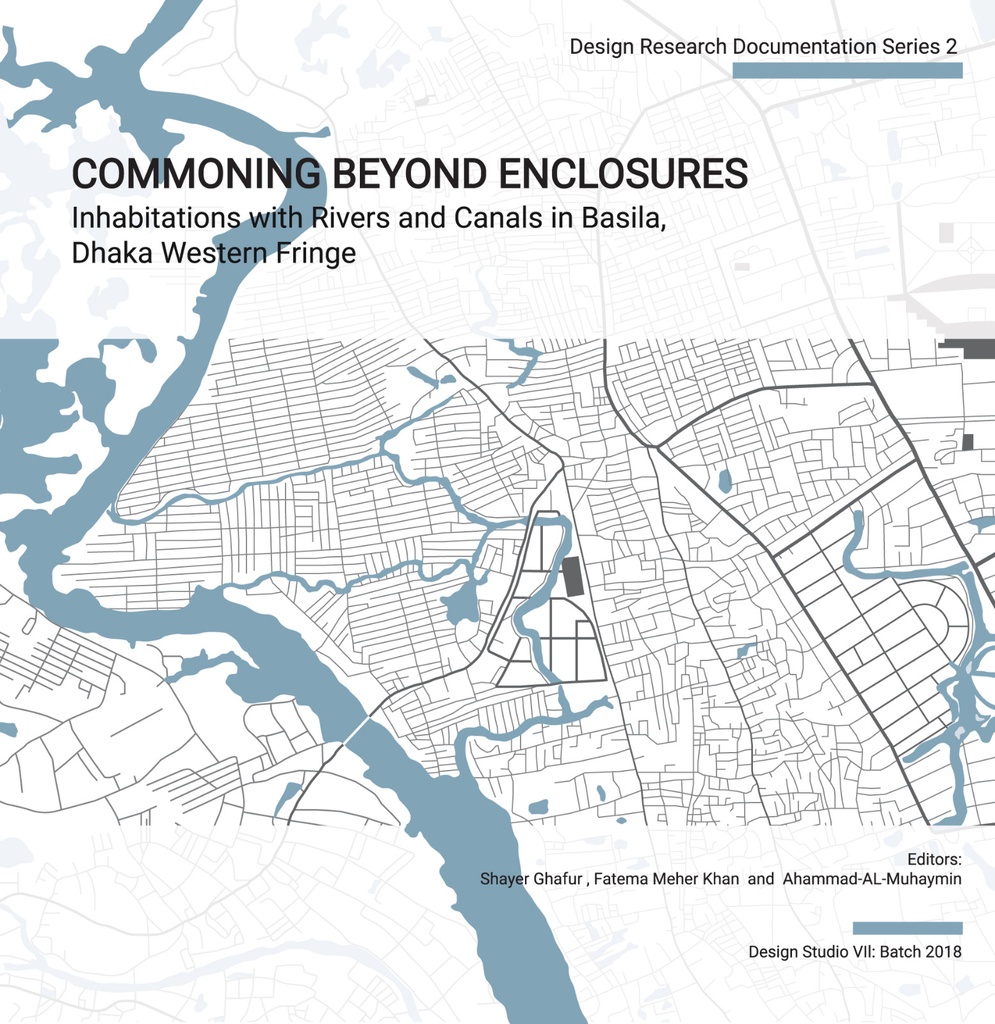


Commoning Beyond Enclosures
Inhabitations with Rivers and Canals in Basila, Dhaka Western Fringe
| Edition: Design Research Documentation Series 2 |
Book Info
Marginal people’s access to public spaces, infrastructure, and ecosystem services—urban resources—is crucial to their place-based inhabitation in Dhaka, as in other major cities of the global South. Urban resources, evident in public spaces, green spaces, water bodies etc., are commons outside the public or private property regimes. Towards an inclusive Dhaka, how marginal people claim urban resources through place-based inhabitation is crucial on two grounds. A deeply entrenched spatial disparity distributes urban resources unevenly, intensifying the plight of marginal people. Side by side, the capitalist appropriation of urban commons as enclosures for accumulation continues converting ecosystem services into propertied land. Commoning beyond Enclosures is a plea for imagining place-based transformative practices that reclaim, repair and rebuild urban commons to contribute to inhabitation by evoking people’s right to the city. The Dhaka Detailed Area Plan 2022-2035 recognizes the significance of urban commons as urban lifelines, but does not show ways and means of engaging spatial planning to benefit the living and livelihoods of marginal people. The absence of conceptualization and formulation of strategies to deliver the benefits of urban lifelines, especially for an increasingly marginalised population in Dhaka, underscores the need to rethink spatial disciplines such as architecture, urban design, landscape and urban planning. While regulatory anomalies persist, an ecosystem of practices with care involving spatial design and planning disciplines is more necessary than their compartmentalization. How marginal people access and use urban lifelines—roads, rivers and canals—in informal livelihood practices as part of inhabitation is the question of design research titled Commoning Urban Lifelines: Inhabitation with Rivers and Canals at Basila, Dhaka Western Fringe, carried out at the Department of Architecture, BUET. This design research is a co-learning enterprise among the stakeholders, students, and design tutors. Commoning beyond Enclosures: Inhabitations with Rivers and Canals in Basila, Dhaka Western Fringe is a design research documentation. Design research on urban lifelines investigated place-based responses to the enclosure of the urban commons in Basila, Dhaka. Agencies of marginal people reclaim urban space through material construction, social collaboration and the building of social infrastructure for informal livelihood practices. It reimagines place-based transformative practices that re-appropriate urban spaces for inhabitation by evoking people’s rights to the city. Imagined urban commoning is a co-learning enterprise implemented through extensive fieldwork, stakeholders’ workshops, and design iterations. Commoning beyond Enclosures serves as a future reference for spatial disciplines, including Architecture, Urban Design, Landscape Architecture, and Planning, as well as for national and international development partners.

Shayer Ghafur
Professor at the Department of Architecture, BUET and founding Coordinator, Cell for Resilient Dwelling (CeRD) within Housing and Settlement Division. Commonwealth Scholar, completed PhD from Oxford Brooks University, UK, 1997, on spatial setting for home-based enterprises in intermediate-sized cities, Bangladesh. Teaches Southern Urbanism and Housing, and Coordinates Housing and Urban Design Studios. Tutor, Designing Resilience in Asia (DRIA) for 2018. Lead Editor, Housing through Homesteads, DRDS 1, (2020).

Fatema Meher Khan
Associate Professor at the Department of Architecture, BUET. Awarded Melbourne International Research Scholarship (2015) for PhD in the University of Melbourne on Dhaka's functional mix and their changing morpholo gies. Interested in research topics related to urban design and planning, morphological aspects, and informal urbanism. Teaches in Architecture, Urban Design and Housing studios. Member, Urban Design and Landscape (UDL) Division, DOA, BUET

Ahammad-Al-Muhaymin
Assistant professor at the Department of Architecture, BUET. Recipient of Australia Award Scholar in completing MLA from RMIT University in 2020 on landscape systems Informed urban settlement to address the landscape everits like flooding and land erosion. Teaches in various architecture studios, Landscape design, vernacular architecture and currently a member secretary of the Urban Design and Landscape (UDL) Division.
RELATED BOOKS
GET THE LATEST NEWS FROM US!
We Never Spam Your Inbox!